Sunday, June 29, 2014

Driving question for Problem Based Learning

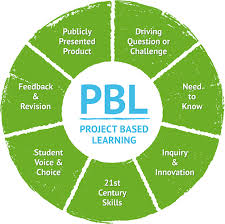
In the What is Project Based Learning (PBL)? article on BIE.org, an essential element for Project Based Learning is the driving question.  This question will be understandable, engage the learning as well as connect to content standards.  

In the Driving Question element of the Project Design Rubric found on BIE’s website, these indicators are listed for best PBL practices in a project:
  • The driving question captures the project’s main focus.                
  • The driving question is open-ended, it allows for more than one reasonable, complex answer.
  • The driving question is understandable and inspiring to students.
  • To answer the driving question, students will need to gain the intended knowledge, skills, and understanding.
My overview of Spending, Saving and The Rainy Day explains my driving question and my subquestions.  My purpose is that the children discover an importance of financial literacy and go out into the world and share their knowledge to parents, important community members, the Rotary Club and the Colorado Department of Commerce to increase awareness.  The focus of this entire project is Financial Literacy.  The driving question should embed the focus of the project.  

http://401kcalculator.org
In my project, the essentials of PBL are incorporated within this driving question and subquestions.  There is a need to know about financial literacy and our spending and saving habits.  These are life skills.  There is a purposeful and authentic audience as I've chosen various platforms to share our PSAs.  Every year, Junior Achievement comes into our school for one day and does an incredible job in the teaching of financial literacy.  When I was thinking of our project, I wanted something that didn't just have to end.  This project could be continued at various levels depending on the opportunity the message gives these students to continue with it.  
In 2nd grade, students still need background knowledge and explicit expectations of team-work, inquiry, as well as a decision making process.  So the subquestions, or mini-lessons that I will need to teach are important in the development of our classroom community.  I believe that this project will encourage inquiry and excitement as they discover the virtual money world around them.  The 21st Century skills will go hand and hand with this project as they are researching and discovering how computers has changed the financial world.  
Here is my driving question:  Is saving money important to my future?
But I am thinking about changing it to:  What should we spend our money on?

All subquestions relate to both.  However in thinking about the students learning about production, good and services, etc... and reading an article about buying in America, made me wonder about the children. Do they need to be thinking about their spending as much as their saving.  Also, I could get into other countries when looking at production and practices, advertising, etc.  I think that there is more of a story with the 2nd question.  But I would like to keep them both.

Sunday, June 22, 2014

Project Based Learning - Exploration - Financial Literacy

After the definition of PBL has been established, I found myself  practicing modified versions of this great process and missing out on some details of it.  It is important for us to teach students to  meet the standards and our approach to teaching can be enhanced using Project Based Learning.  The importance of including all the essentials of this style is equally important.  


This year when working on the social studies, Financial Literacy, I determined that this topic was quite interesting to my students and valuable to them as well.  So as I researched the PBL Units, I found lots of interesting projects that involved financial literacy in the upper grades, but few in the primary grades.  One lesson I found was how High Schoolers Teach Students How To Save and that looked like parts could be used in a great PBL project for my 2nd graders.  Edutopia’s article on Financial Literacy for Elementary Students had some valuable resources as well.

After researching many ideas across the web, I could see many included the essentials needed to complete the whole process that PBL encumbers, but I didn’t find exactly a project to fit my purpose.  We have always been a part of Junior Achievement at our school.  Their information and materials were exactly what my students needed.  I would like to develop a project that would make more impact than just one day in a classroom.  
Source: http://www.cashnotesale.com/

My questions were varied and could include:  
  • What goods and services do you use?
  • How are resources used in various communities?
  • What are some ways to find out about the goods and services used in other communities?
  • How do individuals make and analyze the consequences of financial decisions?
  • How do individuals meet their short- and long-term goals?


Upon reading Making a Case for Financial Literacy, then  finding a great project design tool from BIE.org, and a planning calendar, I am ready to begin my planning.


Other Instructional Resources:
www.jumpstart.org  Jump$tart Coalition website, Clearinghouse
www.nefe.org  National Endowment for Financial Education
www.cee.org  Council for Economic Education
www.ja.org  Junior Achievement
www.federalreserveeducation.org  Federal Reserve ( Piggy Bank Primer)
www.mymoney.gov  US Dept. of Treasury/ US Financial Literacy & Edu.
www.usmint.gov  US Mint
www.savingsmatterss.dol.gov  US Dept. of Labor

Sunday, June 15, 2014

Project Based Learning - What are the considerations?

Source: http://k5stempta.org/
As teachers are incorporating Project-Based learning instruction into their classrooms, they need to help students know and be aware of their own conceptions and help students develop learning strategies to use. Lecturing to students and stressing learning for the right answer is a simpler and more familiar process for teachers then project-based learning instruction.  

Students who will be successful in a PBL environment need to use learning, problem-solving and metacognitive strategies.  Students will also need to have an understanding of what those strategies are and when to use them.  A teacher then needs to model and scaffold this process if a students isn’t using or understanding the strategies necessary so that the PBL environment can become successful.  In turn, teachers need support in these environments in learning how students learn.  Students should have an understanding of the problem before the beginning of a project.  Knowledge of 21st century skills and knowing how to collaboratively work with others can be critical skills that influence success for PBL with students.  It is also extremely helpful if they are motivated, self-directed and an active participant in their own learning. The teacher needs to know the student’s level of understanding about the problem before the project, during the project and what the student learned as a result of the project.  Teachers need to be able to document the student’s learning informally as well as formally.

Many educators promote mastery of content instead of promoting inquiry of knowledge, which is PBL in nature.  Creating a PBL classroom environment that encourages an open-mind set, an inquiry of knowledge, and a place where mistakes are encouraged is difficult.  But risk-taking, using cognitive and metacognitive learning strategies can bring a deeper understanding of content in those PBL environments.  Learners thinking beyond one solution and beyond “the correct answer” is a PBL attribute.  Educators providing real-world connections can support these learners in this environment.

Technology plays a big role in a successful PBL classroom.  It can provide the motivation for students, give them accessibility to information needed and allow for them to authentically showcase their learning in a meaningful way.  However, the teacher again is a key factor.  The teacher needs to be able to understand the process and be able to guide the students and model their learning.  organize that process so that students understand steps necessary in their learning journey.  

Students need to be able to evaluate their own thinking, processes and products in a successful PBL environment.  Teachers then need to provide explicit support for this reflection process so that students can find their errors in the steps they followed, understand why and be able to move forward with their learning.  


Blumenfeld, P. (1991). Motivating Project-Based Learning: Sustaining the Doing, Supporting   the Learning. Educational Psychologist, 26(3/4), 369.
Harvey, S., & Daniels, H. (2009). Comprehension & collaboration: Inquiry circles in action.  
Portsmouth, NH: Heinemann.
Rice, Kerry. Making the move to K-12 online teaching. Pearson Education, Inc., 2012.

Teachers and Machines

TED Talk with Greg Toppo, below.


As I first noted the Ted Talk we were required to watch, I knew that it would spark some great thoughts in my mind.  I have been listening to Ted Talks when they were just “podcasts”.  I loved the quotes from history that still hold true today.  I also enjoyed the progressiveness of those innovators in the past and wonder if we as MET students are embarking just the beginning of tech integration and use.   
When visiting the Google Complex in Mountain View, CA last December, the theme for this professional development was “You Don’t Know, What You Don’t Know!”  Education has always had challenges including lack of teacher training, cost, inaccessibility of equipment, and content appropriateness (Cuban, 1986), and these challenges remain.  The research on educational technology is very new and technology is changing so quickly, how can we catch up?  We must rely on proven strategies that include multiple theories that work with students and then integrate technology to help in this process. We must begin by educating ourselves and continuing to search for what we don’t know.
Before posting this response, I was very interested in everyone’s reflections and in them I linked some information that I thought others may be interested in.  One of my favorite videos on encouraging/teaching innovations is .  
Also, a post discussing the SAMR model was brought up.  Here is helpful blog and pdf that shows technology tools using the SAMR model.  

Resources:
Cuban, L. (1986). Teachers and machines: the classroom use of technology since 1920. New York: Teachers College Press. http://learningspaces.org/cuban.pdf
Ertmer, P.A., & Newby, T.J. (1993). Behaviorism, cognitivism, constructivism: Comparing critical features from an instructional design perspectivePerformance Improvement Quarterly, 6(4), 50-72.
Dunn, J (2013) New Pedagogy Wheel Helps You Integrate Technology Using SAMR Model Edudemic. The Pedagogy Wheel by Allan Carrington is licensed under a Creative Commons Attribution 3.0 Unported License.  
Nashar, R (2012, December 9). Leading Innovation: The 3 Carriage Train.  Retrieved from http://www.youtube.com/watch?v=HEPinFBcBgU&feature=share&list=PLVfEhEZNAFlMD7zhTaOMPYcpjMskYWxq7&index=25
Toppo, G. (2012, September 29). A different way to think about technology in education: Greg Toppo at TEDxAshburn. Retrieved from http://www.youtube.com/watch?v=D17P3kqB3_0

Tuesday, May 13, 2014

Reflections on my Epistemology and Philosophy for EDU504

What new knowledge of learning theory will you take into the classroom with you, and how will that affect the implementation of technology in your instruction? 

I’ve learned the importance of theory over learning styles and how a blend of theories might offer the best practice from teachers and instructional designers. A thorough understanding of learning theories can help me implement and design instruction for my students, determine their level of competence and achieve the learning tasks in a blended learning environment for my 2nd graders.(Ertmer & Newby 1993) Applying appropriate methods for achievement and optimal growth may be influenced by different theories. Proof or evidence of effective methods need continuous study.  
Change can be shaped by goals and the context of learning.  The constructivists view of self-regulated and self-directed students in a student-centered inquiry based classroom is another piece that I would encourage in my classroom as I set up lessons that teach and embrace those beliefs. I use Raz-Kids, an individual personalized reading program, but would like to implement Khan Academy next year as part of my blended learning environment.  Using an inquiry approach to my reading groups with Inquiry Circles in Action (Loertscher, Harvey, & Daniels 2010) would allow me to  teach comprehension and collaboration together.

Two other conditions, that are more connectivist in nature, are group culture and social climate, which I find are key factors when modeling and teaching to our classroom and individual blogs. I want to incorporate my traditional role of “the teacher” to “the facilitator of learning” as then I can become a co-learner in both virtual and physical learning environments of my classroom.  (Poutanen, Parviainen, & Ã…berg 2011)  The conceptual goals for the practice of blended learning are to break ground on organizational communication and to gain knowledge of new theories and experiences of applying them. The understanding these theories will help facilitate the learning process of my students, which is a crucial part of a blended learning environment to ensure engagement and participation.   
Talk is cheap when it comes to technology integration.  Educators that are in front of this storm, need evidence to support their thinking and application.  We can't just try the newest "shiny" toy and expect results.
As I understand from the self-regulated model, goal setting, self-assessment, self-instruction and self-reinforcement are key factors.  With 2nd graders, they continue to need explicit instruction and supported development of reading strategies and comprehension skills. Through assessments (PALS, DRA or the Raz-Kid Assessment) students are placed by the teacher on their own individual level with the Raz-kids program.  They will individually listen to, read and be quizzed on the ebook stories at their level.  The teacher then helps with goal setting for each individual student, which is extremely important in self-regulation.  Raz-Kids program then lets the teacher assign specific ebooks that give additional practice to skills not met on the quizzes.   This program lets the teacher monitor progress efficiently, but puts the students in the drivers seat as they try to meet their goal at their own pace.  However, as the teacher, it is important for me to monitor and explicitly teach concepts that students are showing that they need during Raz-Kids.  Teachers can assign an assessment or running record that can be scored with student present.  All of these pieces used together will provide a solid framework to help children move into that self-regulated model that gives them the self-efficiency to accomplish their goals.  Teachers, though are an integral part of this process in 2nd grade.  
Even though I haven't started using Khan Academy with my students, I see the process similar to Raz-Kids.  Khan Academy helps you place students at their level in math and then builds from there using practice points and videos to help students move along their structured pacing. Again, with 2nd graders, teacher interaction is crucial.
 After a bit of research, I found an article that helped describe self-regulation and self-direction in a classroom using technology enhanced learning.  I would like to implement a more formal structure of goal setting, by keeping a journal of reflections of tasks they don't understand or to progress monitor themselves.  


Cemal Nat, MuesserWalker, SimonBacon, LizDastbaz, Mohammad and Flynn, Ryan (2011) Impact of metacognitive awareness on learning in technology enhanced learning environments. In: eTeaching and Learning Workshop, 1 Jun 2011, The University of Greenwich, London, UK. (In Press) 
Ertmer, P.A., & Newby, T.J. (1993). Behaviorism, cognitivism, constructivism: Comparing critical features from  an instructional design perspective. Performance Improvement Quarterly, 6(4), 50-72.
Loertscher, D. V., Harvey, S., & Daniels, H. (2010). COMPREHENSION AND COLLABORATION: INQUIRY CIRCLES IN ACTION. Teacher Librarian, 37, 4.
Poutanen, P., Parviainen, O., & Aberg, L. (2011). Conditions for self-organizing and creativity in blended learning environments. On the Horizon, 19, 4, 286-296.

Friday, May 2, 2014

Reflection

Reflection may be thought of as an approach or method for improving the quality and depth of our student’s learning. Reflection can be a way of thinking about learning.  It might help individual learners to understand what, how and why they learn. Developing the capacity to make judgments and evaluating one’s own learning may deepen understanding.  Actively thinking about what was experienced and how that might affect change for other learning could be a powerful tool for the learner.


During the course of Integrating Technology in the Classroom Curriculum EDU541, I’ve had many times to reflect on my learning and on what changes I would incorporate another time or another assignment.  Applying what I’ve already learned in my other M.E.T. classes has been a goal of mine that I feel I’ve accomplished.  Please visit the site created for this course.

My belief that there are many ways to creatively reflect on learning, inspired me to create this prezi.
 
I've grown so much with each assignment in this course as I evaluated and understood the necessary steps to integrate curriculum from my district, state and common core standards with technology. The projects, lesson plans, web quests and sites I created will be a useful resource to all of my PLN.


Hinett, K. "Improving learning through reflection - Higher Education ..." 2012. <http://www.heacademy.ac.uk/assets/documents/resources/database/id485_improving_learning_part_one.pdf>