Sunday, June 15, 2014

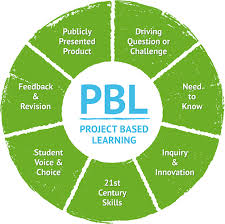
Project Based Learning - What are the considerations?

Source: http://k5stempta.org/
As teachers are incorporating Project-Based learning instruction into their classrooms, they need to help students know and be aware of their own conceptions and help students develop learning strategies to use. Lecturing to students and stressing learning for the right answer is a simpler and more familiar process for teachers then project-based learning instruction.  

Students who will be successful in a PBL environment need to use learning, problem-solving and metacognitive strategies.  Students will also need to have an understanding of what those strategies are and when to use them.  A teacher then needs to model and scaffold this process if a students isn’t using or understanding the strategies necessary so that the PBL environment can become successful.  In turn, teachers need support in these environments in learning how students learn.  Students should have an understanding of the problem before the beginning of a project.  Knowledge of 21st century skills and knowing how to collaboratively work with others can be critical skills that influence success for PBL with students.  It is also extremely helpful if they are motivated, self-directed and an active participant in their own learning. The teacher needs to know the student’s level of understanding about the problem before the project, during the project and what the student learned as a result of the project.  Teachers need to be able to document the student’s learning informally as well as formally.

Many educators promote mastery of content instead of promoting inquiry of knowledge, which is PBL in nature.  Creating a PBL classroom environment that encourages an open-mind set, an inquiry of knowledge, and a place where mistakes are encouraged is difficult.  But risk-taking, using cognitive and metacognitive learning strategies can bring a deeper understanding of content in those PBL environments.  Learners thinking beyond one solution and beyond “the correct answer” is a PBL attribute.  Educators providing real-world connections can support these learners in this environment.

Technology plays a big role in a successful PBL classroom.  It can provide the motivation for students, give them accessibility to information needed and allow for them to authentically showcase their learning in a meaningful way.  However, the teacher again is a key factor.  The teacher needs to be able to understand the process and be able to guide the students and model their learning.  organize that process so that students understand steps necessary in their learning journey.  

Students need to be able to evaluate their own thinking, processes and products in a successful PBL environment.  Teachers then need to provide explicit support for this reflection process so that students can find their errors in the steps they followed, understand why and be able to move forward with their learning.  


Blumenfeld, P. (1991). Motivating Project-Based Learning: Sustaining the Doing, Supporting   the Learning. Educational Psychologist, 26(3/4), 369.
Harvey, S., & Daniels, H. (2009). Comprehension & collaboration: Inquiry circles in action.  
Portsmouth, NH: Heinemann.
Rice, Kerry. Making the move to K-12 online teaching. Pearson Education, Inc., 2012.

Teachers and Machines

TED Talk with Greg Toppo, below.


As I first noted the Ted Talk we were required to watch, I knew that it would spark some great thoughts in my mind.  I have been listening to Ted Talks when they were just “podcasts”.  I loved the quotes from history that still hold true today.  I also enjoyed the progressiveness of those innovators in the past and wonder if we as MET students are embarking just the beginning of tech integration and use.   
When visiting the Google Complex in Mountain View, CA last December, the theme for this professional development was “You Don’t Know, What You Don’t Know!”  Education has always had challenges including lack of teacher training, cost, inaccessibility of equipment, and content appropriateness (Cuban, 1986), and these challenges remain.  The research on educational technology is very new and technology is changing so quickly, how can we catch up?  We must rely on proven strategies that include multiple theories that work with students and then integrate technology to help in this process. We must begin by educating ourselves and continuing to search for what we don’t know.
Before posting this response, I was very interested in everyone’s reflections and in them I linked some information that I thought others may be interested in.  One of my favorite videos on encouraging/teaching innovations is .  
Also, a post discussing the SAMR model was brought up.  Here is helpful blog and pdf that shows technology tools using the SAMR model.  

Resources:
Cuban, L. (1986). Teachers and machines: the classroom use of technology since 1920. New York: Teachers College Press. http://learningspaces.org/cuban.pdf
Ertmer, P.A., & Newby, T.J. (1993). Behaviorism, cognitivism, constructivism: Comparing critical features from an instructional design perspectivePerformance Improvement Quarterly, 6(4), 50-72.
Dunn, J (2013) New Pedagogy Wheel Helps You Integrate Technology Using SAMR Model Edudemic. The Pedagogy Wheel by Allan Carrington is licensed under a Creative Commons Attribution 3.0 Unported License.  
Nashar, R (2012, December 9). Leading Innovation: The 3 Carriage Train.  Retrieved from http://www.youtube.com/watch?v=HEPinFBcBgU&feature=share&list=PLVfEhEZNAFlMD7zhTaOMPYcpjMskYWxq7&index=25
Toppo, G. (2012, September 29). A different way to think about technology in education: Greg Toppo at TEDxAshburn. Retrieved from http://www.youtube.com/watch?v=D17P3kqB3_0

Tuesday, May 13, 2014

Reflections on my Epistemology and Philosophy for EDU504

What new knowledge of learning theory will you take into the classroom with you, and how will that affect the implementation of technology in your instruction? 

I’ve learned the importance of theory over learning styles and how a blend of theories might offer the best practice from teachers and instructional designers. A thorough understanding of learning theories can help me implement and design instruction for my students, determine their level of competence and achieve the learning tasks in a blended learning environment for my 2nd graders.(Ertmer & Newby 1993) Applying appropriate methods for achievement and optimal growth may be influenced by different theories. Proof or evidence of effective methods need continuous study.  
Change can be shaped by goals and the context of learning.  The constructivists view of self-regulated and self-directed students in a student-centered inquiry based classroom is another piece that I would encourage in my classroom as I set up lessons that teach and embrace those beliefs. I use Raz-Kids, an individual personalized reading program, but would like to implement Khan Academy next year as part of my blended learning environment.  Using an inquiry approach to my reading groups with Inquiry Circles in Action (Loertscher, Harvey, & Daniels 2010) would allow me to  teach comprehension and collaboration together.

Two other conditions, that are more connectivist in nature, are group culture and social climate, which I find are key factors when modeling and teaching to our classroom and individual blogs. I want to incorporate my traditional role of “the teacher” to “the facilitator of learning” as then I can become a co-learner in both virtual and physical learning environments of my classroom.  (Poutanen, Parviainen, & Ã…berg 2011)  The conceptual goals for the practice of blended learning are to break ground on organizational communication and to gain knowledge of new theories and experiences of applying them. The understanding these theories will help facilitate the learning process of my students, which is a crucial part of a blended learning environment to ensure engagement and participation.   
Talk is cheap when it comes to technology integration.  Educators that are in front of this storm, need evidence to support their thinking and application.  We can't just try the newest "shiny" toy and expect results.
As I understand from the self-regulated model, goal setting, self-assessment, self-instruction and self-reinforcement are key factors.  With 2nd graders, they continue to need explicit instruction and supported development of reading strategies and comprehension skills. Through assessments (PALS, DRA or the Raz-Kid Assessment) students are placed by the teacher on their own individual level with the Raz-kids program.  They will individually listen to, read and be quizzed on the ebook stories at their level.  The teacher then helps with goal setting for each individual student, which is extremely important in self-regulation.  Raz-Kids program then lets the teacher assign specific ebooks that give additional practice to skills not met on the quizzes.   This program lets the teacher monitor progress efficiently, but puts the students in the drivers seat as they try to meet their goal at their own pace.  However, as the teacher, it is important for me to monitor and explicitly teach concepts that students are showing that they need during Raz-Kids.  Teachers can assign an assessment or running record that can be scored with student present.  All of these pieces used together will provide a solid framework to help children move into that self-regulated model that gives them the self-efficiency to accomplish their goals.  Teachers, though are an integral part of this process in 2nd grade.  
Even though I haven't started using Khan Academy with my students, I see the process similar to Raz-Kids.  Khan Academy helps you place students at their level in math and then builds from there using practice points and videos to help students move along their structured pacing. Again, with 2nd graders, teacher interaction is crucial.
 After a bit of research, I found an article that helped describe self-regulation and self-direction in a classroom using technology enhanced learning.  I would like to implement a more formal structure of goal setting, by keeping a journal of reflections of tasks they don't understand or to progress monitor themselves.  


Cemal Nat, MuesserWalker, SimonBacon, LizDastbaz, Mohammad and Flynn, Ryan (2011) Impact of metacognitive awareness on learning in technology enhanced learning environments. In: eTeaching and Learning Workshop, 1 Jun 2011, The University of Greenwich, London, UK. (In Press) 
Ertmer, P.A., & Newby, T.J. (1993). Behaviorism, cognitivism, constructivism: Comparing critical features from  an instructional design perspective. Performance Improvement Quarterly, 6(4), 50-72.
Loertscher, D. V., Harvey, S., & Daniels, H. (2010). COMPREHENSION AND COLLABORATION: INQUIRY CIRCLES IN ACTION. Teacher Librarian, 37, 4.
Poutanen, P., Parviainen, O., & Aberg, L. (2011). Conditions for self-organizing and creativity in blended learning environments. On the Horizon, 19, 4, 286-296.

Friday, May 2, 2014

Reflection

Reflection may be thought of as an approach or method for improving the quality and depth of our student’s learning. Reflection can be a way of thinking about learning.  It might help individual learners to understand what, how and why they learn. Developing the capacity to make judgments and evaluating one’s own learning may deepen understanding.  Actively thinking about what was experienced and how that might affect change for other learning could be a powerful tool for the learner.


During the course of Integrating Technology in the Classroom Curriculum EDU541, I’ve had many times to reflect on my learning and on what changes I would incorporate another time or another assignment.  Applying what I’ve already learned in my other M.E.T. classes has been a goal of mine that I feel I’ve accomplished.  Please visit the site created for this course.

My belief that there are many ways to creatively reflect on learning, inspired me to create this prezi.
 
I've grown so much with each assignment in this course as I evaluated and understood the necessary steps to integrate curriculum from my district, state and common core standards with technology. The projects, lesson plans, web quests and sites I created will be a useful resource to all of my PLN.


Hinett, K. "Improving learning through reflection - Higher Education ..." 2012. <http://www.heacademy.ac.uk/assets/documents/resources/database/id485_improving_learning_part_one.pdf>

Saturday, April 26, 2014

Accessibility Features with Chrome

Google has incorporated web accessibility within its use of Chrome Browser, Chrome Extensions and other Google Apps for Education to help with our diverse learners.  

Web Content Accessibility Guidelines (WCAG) 2.0 are important to all our students. Following these guidelines will make content accessible to a wider range of people with disabilities, including blindness and low vision, deafness and hearing loss, learning disabilities, cognitive limitations, limited movement, speech disabilities, photosensitivity and combinations of these. Following these guidelines will also often make Web content more usable to all students.

Google's Administrative Guide to Accessibility is a summary of accessibility information for Google Apps. It is to help understand the current state of accessibility for each supported application in the Google Apps suite and how it can meet the needs for all students. This guide’s main focus is on accessibility needs of blind and low-vision users. Deaf and hard-of-hearing users can benefit from the accessibility features of other Google products at the Google accessibility site.

The Chrome browser supports assistive technology including some screen readers and magnifiers. It offers people with low vision a number of tools, including full-page zoom and high-contrast color.The reader for Chrome that is already installed on Chromebooks is ChromeVox. ChromeVox is a screen reader for Chrome which brings the speed, versatility, and security of Chrome to visually impaired users.

Chrome Extensions are extra features and functionality that you can easily add to your Chrome browser to customize it with functionality you need. There are many extensions which improve accessibility or which help developers create accessible web applications. They are easily added to your Chrome Browser by going to the Chrome Web Store. There are many extensions to choose from. Over 300k use the extension Smooth Gestures.

There are many Google Apps for Education accessibility resources. Google Search, Gmail, Calendar, Docs and Sites, Maps and ebooks are just a few. Accessibility resources for these above apps and more are easily added to the Chrome Browser. Google provides 508 VPAT Documents to show the compliance on the above listed Apps for Education. Google continues to develop and test extensions for the Web that help disabled learners.

Meddaugh, JJ. "A First Look at the Accessibility of the Google Chrome Operating System." 14.5 (2013).

Saturday, April 19, 2014

Maintaining A Growth Mindset Amongst The Obstacles of Technology Integration


  Now that computers have found their way into virtually every school and classroom in the country and the ratio of computers to students has increased dramatically, (Maddux, Johnson 2009) can educators use these technology tools to enrich learning environments?

The challenges that teachers face daily of integrating technology into their classroom is abundant.  Technology funding and device equality from school to school in our district shows digital divide.  The movement to obtain and upgrade technology structures that are necessary for PARC and CMAS testing will continue to prove funding difficulties.  Another major obstacle for educators is the excellent and ongoing training opportunities and in-service education needed to integrate  technology effectively isn’t apparent in most school districts.  Technology training and education is self-regulated by the interested individual teacher or sub-groups.  One of the  biggest criticism of integration of technology into classrooms and content areas is that Higher Education has not been successful in providing leadership. Leadership is needed by academic or practitioners that is soundly supported by research and development projects that give evidence to support the effective and efficient practices in schools and at all levels.  This lack of research could lead to technology integration being thought of as the latest fad or fashion.

“Let’s make sure that the quality of the content we put in front of our kids
                  is measured by research rather than by “likes.”” -Mary Cullinane

Cullinane (2014) also states that investment in research is needed on brain science to improve the teaching and learning process.  This will enable curriculum experts, educators and content providers to understand the goal of education is learning, not just using technology. Used effectively, technology can support the learning process in many ways.

     Developing and maintaining a growth mind-set about technology is imperative when implementing it into your student’s curriculum content.  By embracing the challenges and obstacles as a classroom teacher, you can model problem-solving first hand. My 2nd graders know some strategies if issues of internet connectivity arise. (They sit at table by door - that is where the best wifi signal is.)  Demonstrating failure is an opportunity to learn in front of your students, and can be a powerful tool.  (Students understand and love gaming online, and know what it means to fail before they succeed.)  Educator’s effort can be seen not as something useless to be avoided but a necessity to grow and master useful skills.

     The growth mind-set educator will know that there will be criticism and negativity when applying theory and technology.   However, using research based, theory based technology applications will bring credible skills into the classroom.  Learning from the success of others who have participated in quality technology applications is imperative.  As new technologies are discovered, evaluation and research to the ties of student learning are important.  Understanding that having a growth mind-set will unblock the highway to digital learning and let you start to visualize the beautiful sights along the way (while you are waiting for something to load).

     So while obstacles and challenges can’t be avoided in technology integration, maintaining a growth mind-set about this topic is essential as we move forward with our students.


Cullinane, Mary (2014) OPINION: Ban "Digital" Learning  Retrieved 4/18/14 from:                  
     https://www.edsurge.com/n/2014-04-11-opinion-ban-digital-learning
Maddux, C. D., & JOHNSON, D. (2009). Theories, Concepts, and Techniques: Too Much of
     a Number of Good Things?. Computers In The Schools, 26(3), 165-168.              
     doi:10.1080/07380560903129086
Richard, M.G. (2014) Fixed Mindset vs. Growth Mindset: Which One Are You? Retrieved
      4/17/14  http://michaelgr.com/2007/04/15/fixed-mindset-vs-growth-mindset-which-one-are-you/

Sunday, April 13, 2014

Relative Advantage of Using Technology in the Content Areas


Educational Technology is constantly changing.  Educators need to continuously study and practice facilitating this learning process using the most appropriate tools available.  These tools enhance the classroom experience by providing various ways to engage and teach our students. As classrooms are becoming more student-centered, we need to evaluate how to effectively integrate technology.  As more and more teachers are using technology, we are finding that students are more engaged and interested when we are integrating quality tools.  As educators know there isn't "the best tool" for everyone. There also is specific time that the teacher-centered classroom is necessary. Effective evaluation of our content areas and standards are necessary. Below are a few examples of the way information technology can support and enhance teaching and learning of the content areas:

  • Telecommunications and video tools such as blogs, google hangouts, or skype provide a means for dialogue, discussion, and debate -- interactivity that leads to the social construction of meaning. Students can talk with other students, teachers, and professionals in communities far from their classroom. Telecommunications tools can also provide students access to many different types of information resources that help them understand both their culture and the culture of others.
  • Networked writing programs such as Google Apps, blogs and wikis, provides a unique platform for collaborative writing. Students can write for real audiences who respond instantly and participate in a collective writing activity that can include global cultures as well.
  • Schoology, Edmodo, and Blendspace are providing a place online where teachers can virtually set up their assignments or activities and students can communicate, write, watch videos and collaborate with their classmates and teacher while learning.
  • Simulations can make learning meaningful by situating something to be learned in the context of a "real world" activity such as building a volcano or experimenting with matter.
  • Scratch and Codeacademy.com are a few sites that encourage children to learn code in a fun and effective environment that includes a social aspect to it.
The use of technology allows new connections between students and their learning within the the classroom. Students are able to apply their knowledge in student-centered learning environments more than ever before in large part to the use of technology.  As the development of technology applications continue to grow, online learning will also grow.
Technology also is providing unlimited ways for learners to interact locally and globally.  This authentic learning by connecting classrooms with other classrooms, professionals or experts, provide a meaningful experience for the students.


Honey, M., Culp, K. M., & Spielvogel, R. (1999). Using technology to improve student achievement. Pathways to School Improvement [Online].
Available:http://www.ncrel.org/sdrs/areas/issues/methods/technlgy/te800.htm


Angelina, S. & Jimoyiannis, A. (2012). Educational Blogging: Developing and Investigating Students' Community of Inquiry. In A. Jimoyiannis (Ed.), Research on e-Learning and ICT in Education (pp. 169-182). New York: Springer.